Agent security and MCP governance: guardrails companies need now
MCP connects AI agents to real tools and data. Without authorization, audit trails and least privilege it can become a new shadow-IT risk.
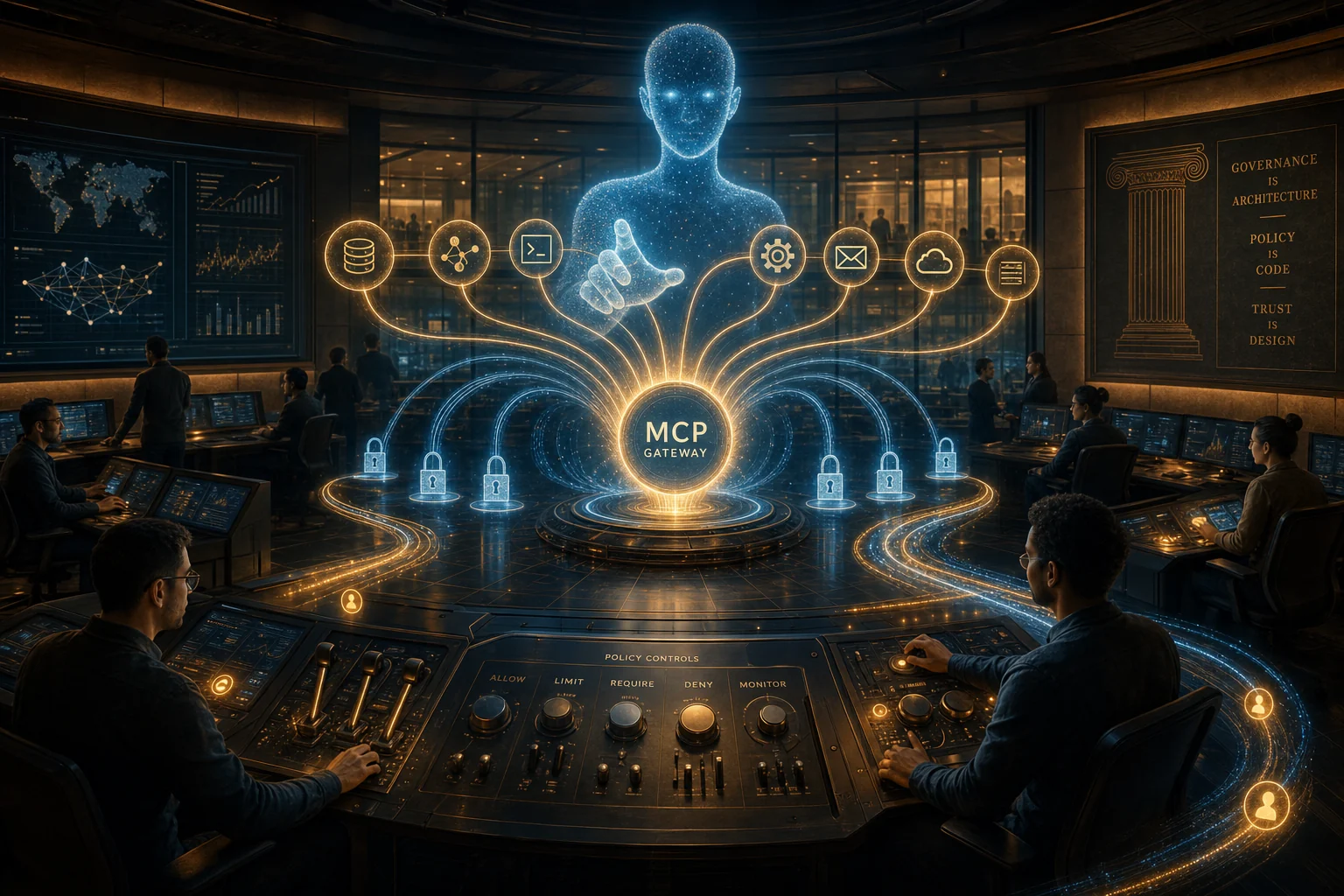
The Model Context Protocol packages an old security problem in a new form: how do you connect intelligent systems to real company data without giving them too much power? MCP standardizes tool access. That is exactly why it is attractive — and risky.
Once an agent can read tickets, fetch files, query databases or trigger internal APIs, it is no longer just a chat window. It becomes a non-human actor inside the enterprise environment. For security teams, that means prompt hardening is not enough. The decisive question is what action the agent is actually allowed to perform in a specific context.
Why MCP governance is not just a prompt problem
Many safety concepts start at the model layer: strengthen the system prompt, filter unwanted output, detect jailbreaks. That is useful, but incomplete. The dangerous part often starts where the model can operate tools.
An agent can answer politely and still see too much data. It can sound compliant and still trigger a risky tool chain. It can follow a malicious instruction hidden in a document, web page or email rather than in the chat itself. MCP therefore needs a governance layer outside the model.

Least privilege per tool call
The most important principle is simple and uncomfortable: an agent should never be able to do more than the current task requires. That applies not only to user roles, but to every single tool call. May this agent read this ticket? May it export this file? May it write a change or only draft a proposal?
Policy decision points, dynamic authorization and gateway layers point in the right direction. MCP servers should not treat permissions as a static trust assumption. They should check who is asking, on whose behalf, which resource is involved and how risky the next action is.
The gateway as control point
A robust architecture does not assume that every team will secure every MCP server perfectly. A controlled path is safer: agents speak through a gateway or proxy that enforces allowed servers, tools, scopes, quotas and logging centrally.
That gateway can filter risky tool descriptions, sanitize suspicious responses, apply rate limits and require human approval. It is the point where “the agent can reach everything” becomes an auditable workflow.
Auditability determines trust
For production agents, seeing the final answer is not enough. Teams need to reconstruct which input led to which tool call, which data was read, which policy decision applied and who approved a risky step.
Without audit trails, governance becomes a claim. With them, security, legal and engineering can verify that an agent stayed within its boundaries. This matters especially for long-running sessions and workflows that touch several systems in sequence.
Relevant tools on Utildesk
Teams building production agents should not treat the tool layer as an afterthought. OpenAI GPT Agents represent the platform path for action-capable assistants, LangChain and CrewAI show common framework routes for orchestration, and the OpenAI API is often the operational surface where authentication, cost controls and logging need to be designed properly.
A practical company checklist
A useful starting point is a small, hard checklist:
- Create an inventory: Which agents, MCP servers and API tokens already exist?
- Reduce scopes: Separate read and write access, limit exports and protect production actions.
- Enforce a gateway: Avoid uncontrolled direct connections to arbitrary MCP servers.
- Log tool calls: Store input, decision, resource and result in a reviewable way.
- Define human approval: Require approval for exports, write access, deployments and irreversible actions.
- Set quotas: Limit loops, mass queries and runaway costs technically.
These steps are less glamorous than an agent demo, but they decide whether the system can survive everyday use.
Conclusion: agents need operational safety, not only intelligence
MCP is a strong integration step because it brings agents from isolated chats into real work environments. That is exactly why governance must be designed early. If permissions, logs and gateways are added only after the first incident, the hardest part has already been placed too late.
The safe direction is clear: least privilege, dynamic authorization, controlled gateways, audit trails and human approval at the risky points. Then MCP can become a reliable interface for productive agents rather than another layer of shadow IT.