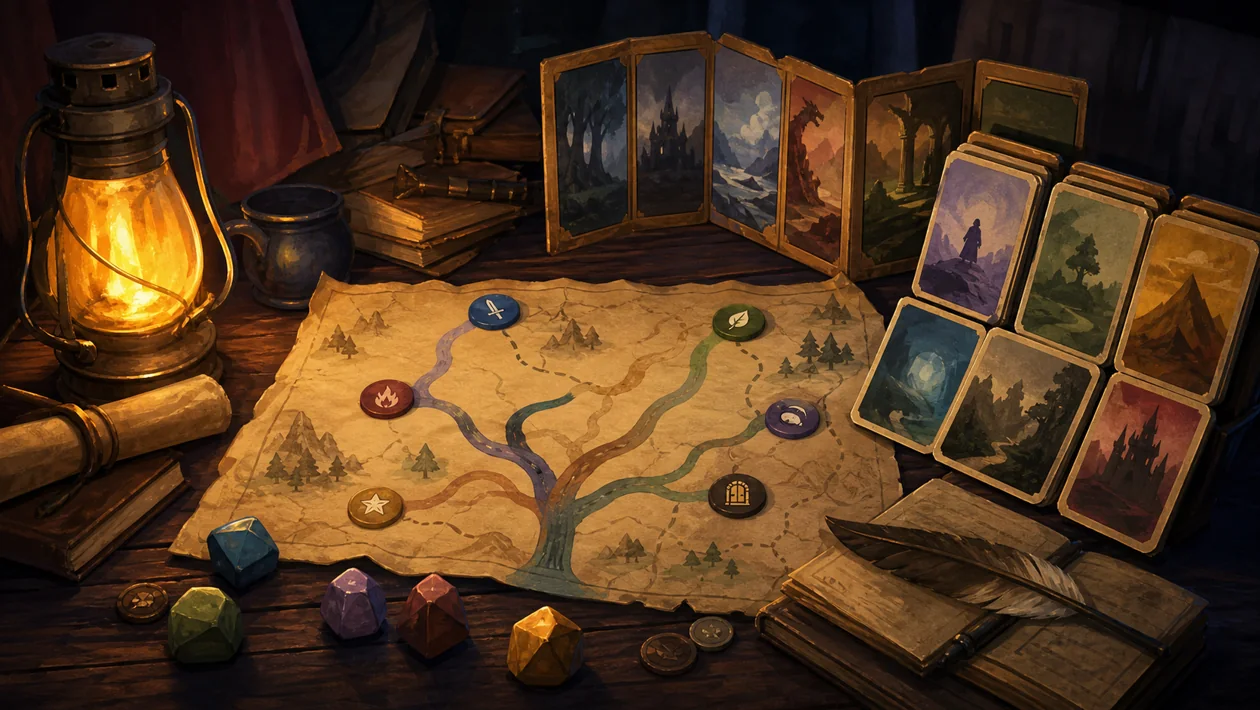
AI Dungeon is a text-based roleplaying environment where a language model responds to player input and generates the next scene in an open-ended story. You can start from a ready-made Scenario, build a setting with your own characters and rules, or write directly in Story mode. That distinction matters: the output is not a finished novel, but an ongoing game whose direction you refine one turn at a time.
Who is AI Dungeon for?
It suits players who prefer reacting to a world rather than following a fixed plot. Writers can also use it to explore dialogue, conflicts, and alternate directions before drafting them properly. The most credible use cases are solo adventures, improvised roleplay, and small creative prototypes. Anyone who needs a consistent manuscript, reliable facts, or publication-ready copy should treat AI Dungeon as a source of raw material, not as an editor.
How does a typical session work?
A Scenario can provide the opening and include Plot Essentials, an Author's Note, Story Cards, placeholders, and branching choices. You then steer the story with Do, Say, or free Story inputs. A practical routine is to define the setting, tone, and boundaries first, play a short scene, correct surprising output with a precise instruction, and record important facts in the plot components. For a group, also decide who maintains the world and who reviews content that may be unsafe or unsuitable.
Which features matter in practice?
- Scenarios: Reusable starting templates that can remain private, be shared, or be published. Multiple-choice and Character Creator Scenarios support more guided openings.
- Plot Essentials and Author's Note: Short guidance that should remain influential during generation. They shape direction and tone but cannot replace clear player input.
- Story Cards: Triggered world information. A card enters context when a relevant word appears, so concise entries and deliberate triggers are more useful than a large lore dump.
- Memory System: Auto Summarization and Memory Bank help longer adventures retain important information. They reduce forgetting but do not guarantee continuity.
- Scripting: Scenario creators can add JavaScript for custom behavior and quality-of-life features. It is an advanced extension, not a substitute for reviewing code and permissions.
Concrete use cases
- Solo campaign: Define a setting, three important characters, and two boundaries. Play ten to fifteen turns, inspect what the AI remembered, and revise only the entries that failed in practice.
- Worldbuilding: Use Story Cards for places, factions, and recurring terms. Export the cards periodically so a useful setting is not trapped in a single Adventure branch.
- Creative workshop: Give each participant the same Scenario template and compare how decisions change the story. Share only material whose rights and visibility are clear.
- Multiplayer session: Agree on who can change rules and Plot Essentials. A short style guide prevents every player input from reinventing the character or tone.
What are the limits?
The model can forget details, make a character behave inconsistently, or take a scene in an unwanted direction. Context length is a real technical constraint: Plot Essentials, Story Cards, Memory, and the previous story all compete for the same context. Long cards will not necessarily be followed in full. Triggers can also fire too late or too often. Scripting and public Scenarios add review work. AI Dungeon is therefore not a replacement for a deterministic rules engine, version control, or human editing.
Privacy, rights, and cost
According to the provider, private content is available only to its creator by default and encrypted on the server; unlisted content can be reached by link, while published content is public. Visibility is a setting, not a blanket permission to use confidential work data. For real names, internal information, unpublished manuscripts, or sensitive roleplay, review the provider's terms, deletion process, and data handling before adoption. The provider says “Improve the AI” is off by default but can be enabled in account settings.
AI Dungeon has a free entry point and paid memberships. Paid tiers differ in areas such as models, context, Memories, and Credits, and both prices and entitlements can change. Budget for more than the subscription: image or context usage, moderation, and time spent correcting continuity errors are part of the operating cost.
Editorial assessment
AI Dungeon is a good fit for open-ended, playful storytelling when surprise matters more than full plot control. Its value is clearest in a bounded setting, with maintained Story Cards and a person responsible for correcting continuity. That makes it a reasonable starting point for a private creative test or a small roleplaying group. A public community or commercial writing project needs moderation, rights checks, and an export or archive plan. Choose an alternative when you primarily need polished prose, deterministic branching, or a persistent multiplayer world with fixed rules.
Open frequently asked questions
FAQ
Can I create my own Scenario in AI Dungeon?
Yes. You can configure the prompt, Plot Essentials, Author's Note, Story Cards, placeholders, and, depending on the Scenario type, choice paths. Start small because every additional rule needs maintenance and testing.
Will AI Dungeon forget important details?
It can. The Memory System and Story Cards help, but they depend on context and triggers. Keep central facts short, use distinctive triggers, and inspect activation in the Context Viewer.
Are my Adventures public by default?
No. Private, unlisted, and published content have different visibility rules. Check the status of the specific item before sharing and never publish confidential material.
Is AI Dungeon free?
There is a free entry point and paid memberships. Plans differ in models, context, Memories, and Credits; check the provider for current terms and pricing.
Can I use AI Dungeon to write a finished book?
You can use it for ideas or variations, but not as automatic final editing. Continuity, style, facts, rights, and sensitive material need human review before publication.