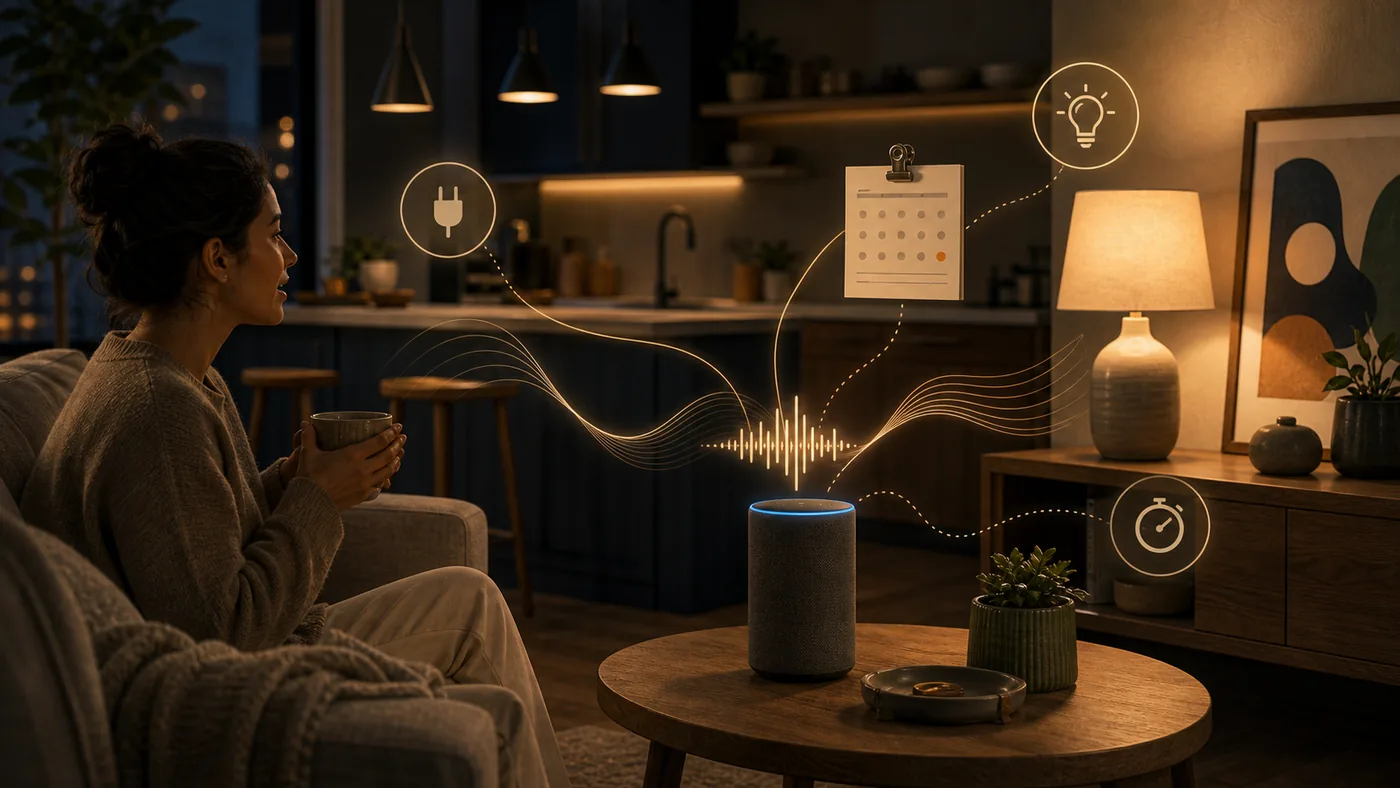
Amazon Alexa is a voice-controlled virtual assistant that simplifies numerous tasks in everyday life. Through integration with smart home devices, control of music, answering of questions, and more, Alexa provides a versatile support for users. The technology is based on artificial intelligence and allows for intuitive control via speech.
For whom is Amazon Alexa suitable?
Amazon Alexa is suitable for anyone who wants to simplify their daily routine through smart speech control. Particularly suitable is Alexa for people who want to connect their home with smart devices to control lighting, heating, or security systems conveniently by voice. Also, for those who want to quickly access information, manage shopping lists, or enjoy entertainment offers, Alexa is a practical solution. Both tech-savvy individuals and experienced users benefit from the simple interface and the wide range of functions.
Main Functions
Voice control for smart home devices (lights, thermostats, outlets, etc.)
Music and media playback through various streaming services
Answering questions from diverse knowledge areas
Creating and managing reminders, appointments, and shopping lists
Controlling compatible household appliances
Integration of Skills and extensions for individual adaptation
Phone and message function within the Alexa ecosystem
Support for multiple languages and user profiles
Routines for automating workflows
Compatibility with various devices such as Echo speakers, Fire TV, and third-party hardware
Practical workflow: Amazon Alexa should be tested against a real service case with intake, prioritization, response, escalation, and follow-up, not only against a polished demo.
Quality control: In daily use, Amazon Alexa needs a way to document response time, handoff quality, and customer satisfaction so another person can review the result.
Team handoff: Amazon Alexa becomes more useful when outputs, decisions, and open questions remain understandable for other roles.
Advantages and Disadvantages
Advantages
Intuitive voice control simplifies the interface
Wide compatibility with smart home devices from various manufacturers
Large selection of Skills to expand the functions
Regular updates improve performance and security
Freemium pricing allows entry without costs
Broad ecosystem and integration with Amazon services
Stronger in daily work when Amazon Alexa is used for clearly bounded tasks rather than every possible side problem.
Creates more value when Amazon Alexa exposes recurring friction around customer communication, availability, and clean handoffs between channels instead of merely adding another interface.
Disadvantages
- Privacy concerns due to continuous microphone activation
- Dependence on internet connection for full functionality
- Partial compatibility with certain devices
- Voice control can be unreliable in noisy environments
- Some extended functions require an Amazon account and registration
Prices & Costs
Amazon Alexa is generally available in a freemium model. The use of voice control and basic functions is free. Additional premium services or Skills may incur additional costs, depending on the provider or plan. The hardware, such as Echo devices, is sold separately and is subject to separate pricing.
Open frequently asked questions
FAQ
1. Do I need an Amazon account to use Alexa?
What should a Amazon Alexa pilot look like?
Start with a bounded process, a small group and a clear success criterion. Check output quality, permissions and handovers before expanding the scope.
Which data should not be processed in Amazon Alexa without review?
Sensitive or confidential content should wait until contract terms, access, storage and deletion controls have been reviewed. Escalate uncertainty to the responsible privacy owner.
When is an alternative to Amazon Alexa the better choice?
Choose an alternative when the need is occasional, a required integration is missing, or administration and cost outweigh the practical benefit.
Yes, for setting up and using Amazon Alexa, an Amazon account is required.
2. Does Alexa work without an internet connection? Most Alexa functions rely on an active internet connection. Without internet, most voice commands are not available.
3. Which devices are compatible with Alexa? Alexa is compatible with a wide range of devices, including Echo speakers, smart home devices from various manufacturers, Fire TV, and other third-party hardware.
4. How secure is the use of Alexa in terms of privacy? Amazon stores voice recordings to improve the service, which raises privacy concerns. Users can adjust their privacy settings and delete recordings.
5. Can Alexa distinguish between multiple users? Yes, Alexa supports multiple user profiles and can differentiate between them to provide personalized responses.
6. Are there limitations to speech input? Alexa supports multiple languages, but speech recognition can vary depending on accent and ambient noise.
7. Which smart home devices can I control with Alexa? Alexa is compatible with a wide range of devices such as lamps, thermostats, outlets, security systems, and more, depending on the manufacturer.
8. Is Alexa also suitable for business or commercial use? Alexa is primarily designed for personal use, but there are specialized solutions for businesses, depending on the business requirements.
A small, bounded test is usually enough to learn whether Amazon Alexa fits. It should show whether response time, handoff quality, and customer satisfaction improve without creating new shadow processes.
A feature list is not enough here. The team should define the task Amazon Alexa is meant to relieve, who accepts the result, and when the pilot counts as a miss.
9. How should a team test Amazon Alexa? Use a small real use case. Define the goal, owner, and success criteria first, then compare effort, quality, and remaining friction around Amazon Alexa.
10. When is Amazon Alexa a poor fit? It is a poor fit when channels, ownership, and escalation rules are not clearly defined and the team has no capacity for setup, review, and ongoing care. Then Amazon Alexa mostly moves the problem around.
Editorial assessment
Amazon Alexa can be useful when it is embedded in a clear process. Without ownership and review rules, the value can remain vague even if the product looks convincing in a demo.
A useful evaluation starts with a real service case with intake, prioritization, response, escalation, and follow-up. Only then can a team decide whether Amazon Alexa is just a nice add-on or a dependable part of the workflow.
What to watch: The team should see whether Amazon Alexa makes response time, handoff quality, and customer satisfaction more stable after the test, not just more impressive in a demo.
Good starting point: Keep the first Amazon Alexa trial close to daily work, with one owner and a short review after the result is delivered.
Common pitfall: Amazon Alexa disappoints when channels, ownership, and escalation rules are not clearly defined.
Adds complexity when channels, ownership, and escalation rules are not clearly defined before the rollout and decisions are made informally. With Amazon Alexa, the team should clarify this before rollout.
If review and maintenance disappear, Amazon Alexa quickly loses reliability in shared workflows.
Beyond the list price, Amazon Alexa should be evaluated by the cost of adoption. Relevant factors include setup, phone numbers, integrations, training, and ongoing administration. For team use, these indirect costs can matter more than the monthly or annual subscription itself.
Workflow and rollout
A useful start with Amazon Alexa begins with one concrete workflow and a small user group. Define the input, expected outcome and manual checkpoint before adding more automation or permissions. Record who approves the result and how a failed step is reversed. A focused pilot makes it clear whether Amazon Alexa holds up in daily work or only looks convincing in a demo.