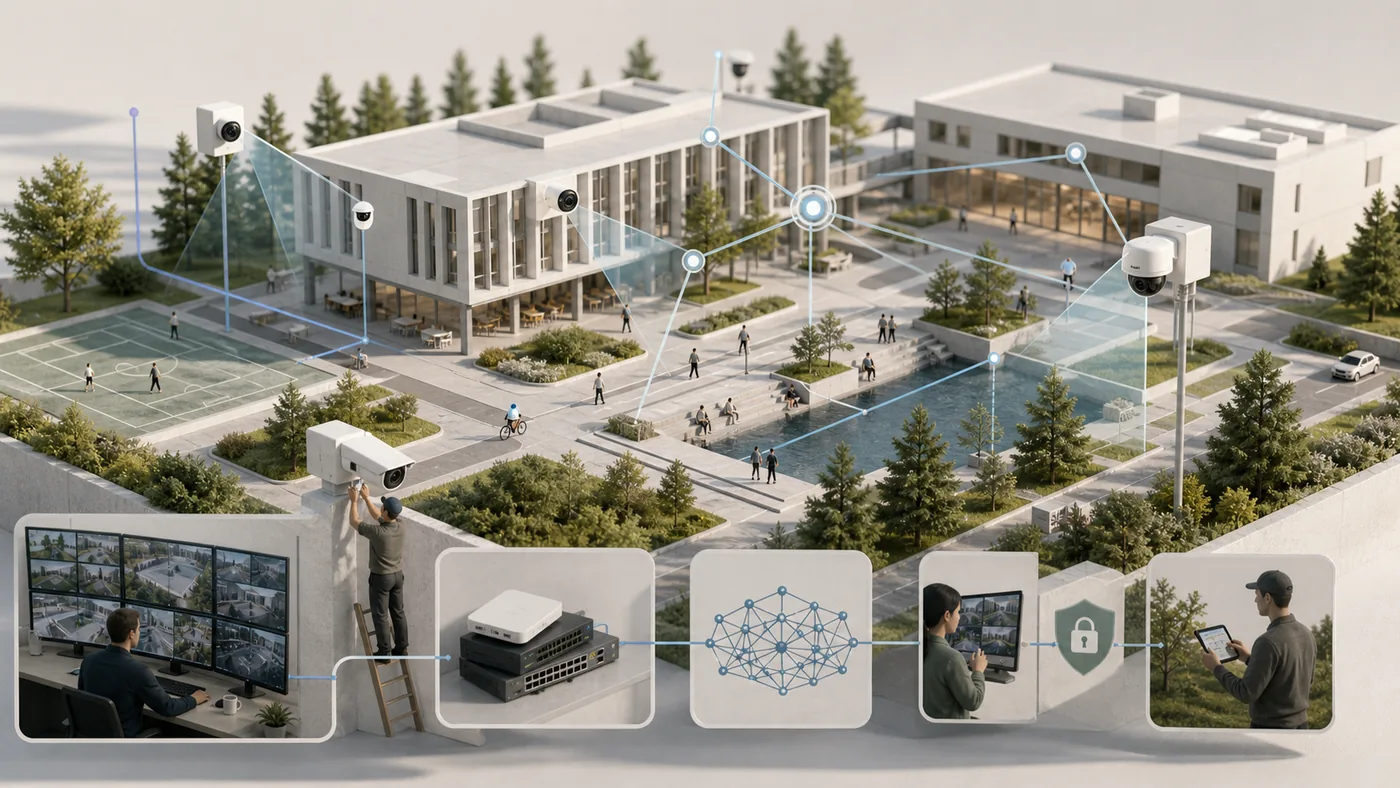
Axis Communications is not one surveillance app but a professional network-security ecosystem: cameras, video and audio components, intercoms, access control, device management and analytics applications. The common foundation is IP-based infrastructure. Actual capabilities therefore depend on the model, AXIS OS, installed application, VMS, licence and configuration.
Axis should not be compared with a single cloud app. Its devices can be integrated into an existing video-management environment. Teams that want an Axis-centred stack can use AXIS Camera Station Pro as a server-based VMS on a private network, with optional cloud connectivity. A different camera or VMS strategy may still be the better choice for a small, standardised or cloud-only requirement.
Who is Axis Communications for?
Axis is relevant to businesses, public bodies, retail, logistics, industry, transport and integrators that need to operate security-relevant sites over time. Typical requirements include live viewing, searchable recordings, incident review, access control, audio announcements or the controlled use of camera data inside an existing security process.
For one private camera, the portfolio is usually excessive. For a professional site, it becomes interesting when image quality is only one part of the decision and the team also has to own installation, network design, firmware, roles, storage, replacement planning and documented incident response.
Typical use cases
- Site security: Monitor entrances, outdoor areas, production floors or warehouses with a suitable camera type and a justified retention rule.
- Incident review: Search recordings, mark a relevant time window, approve an export and document the decision.
- Access and intercom: Bring door events, intercom workflows and video together where that improves a defined operating process.
- Traffic and perimeter work: Evaluate PTZ, panoramic, thermal or other specialist cameras against the real environment rather than a product demo.
- Operations and maintenance: Inventory devices, keep AXIS OS current, standardise configurations and make failures visible.
What the platform does in practice
The hardware range includes dome, bullet, box, PTZ, panoramic, modular and thermal cameras, as well as models for specialised environments. Depending on the device, edge applications can add detection, counting, tracking or other analytics. An analytics flag is a prompt for review, not proof and not an independent legal judgement.
AXIS Camera Station Pro is the obvious Axis-centred VMS option. It handles live and recorded video, search, exports, alarms and logs, and can support access control, audio and multi-site operations depending on the setup. It is server-based and can run on a private network; web, mobile and optional cloud access need separate planning. Third-party integrations are possible, but exact compatibility belongs in the pilot.
A realistic rollout workflow
Start with one site, a small camera set and one clearly defined incident type. Record the view, lens, lighting, night conditions, network path, time source, storage requirement and the people allowed to review material. Then test a complete case: event, review, decision, export, approval and deletion.
Only after that should the team add more cameras, analytics applications, door control or more sites. Measure false alarms, time to review, unresolved events and maintenance effort. This shows whether the system reduces operational work or merely creates more equipment to administer.
Strengths and limitations
Strengths
- A broad professional portfolio rather than one camera form for every environment.
- Edge processing can keep suitable analytics close to the data source and reduce unnecessary transfer.
- AXIS Camera Station Pro offers a coherent server-based VMS path with search, export, alarms and integrations.
- AXIS OS, device-management tools and hardening guidance give IT teams concrete operating controls.
- The ecosystem is built for integration, although openness and feature support still need to be tested per model and system.
Limitations
- The selection is complex: camera, lens, mounting, light, network, storage, VMS and applications must fit together.
- Purchase price is only one part of the total: installation, server, licences, storage, maintenance and replacement equipment add up.
- Analytics can create false positives and cannot replace a privacy review or human decision.
- A private network is not a security design. Accounts, segmentation, updates, certificates, backups and remote access need owners.
- A simpler camera or cloud service may be more economical for small, infrequent or fully cloud-based scenarios.
Privacy and secure operations
Video, audio, access events and analytics metadata can be sensitive personal data. Before rollout, define purpose, notices, camera angles, retention, export, deletion and roles for the specific site. Do not enable face recognition, licence-plate recognition or similar features simply because they appeared in a demo; necessity, lawfulness and proportionality need a separate review.
For IT, inventory, current AXIS OS versions, strong accounts, least privilege, HTTPS, network segmentation and controlled remote access are part of normal operation. Axis hardening guides provide technical direction, but they do not replace a local risk assessment, patch ownership or an incident exercise.
Pricing and ongoing cost
There is no useful single price for Axis Communications. Cost depends on camera and lens type, mounting, recorder or server, retention period, number of sites, VMS and analytics licences, support, installation and maintenance. Some products are hardware purchases; other capabilities are added through licences or services. A serious quote should therefore include multi-year operation and a replacement or upgrade plan, not only the camera line item.
Editorial assessment
Axis Communications is a strong candidate for professional, hardware-led security projects where the organisation wants a maintainable long-term infrastructure and a clear operating process. The value is not automatically an AI feature; it comes from the fit between hardware, VMS, maintenance and security governance. We would test Axis with a real incident and scale only after roles, storage and privacy controls work in practice.
Open frequently asked questions
FAQ
Is Axis Communications a cloud surveillance product?
No. Axis offers devices and software for different architectures. AXIS Camera Station Pro can run as a server-based system on a private network; optional cloud functions and remote access must be configured and assessed separately.
Do I need AXIS Camera Station Pro for Axis devices?
No. Axis devices can be integrated with suitable third-party VMS and security environments. Check ONVIF, model, analytics and licence compatibility for the exact design before purchase.
Can Axis analytics decide a security incident automatically?
No. Detection, counting or tracking can prioritise review. A person must own the interpretation, false-alarm handling, escalation and any evidence export.
How should a sensible pilot start?
Use one site, one real event type, a small camera set and the full path from review to deletion. Also test night conditions, backlight, network failure, timestamps, roles and controlled export.
What drives cost beyond the camera price?
Retention, frame rate, resolution, server or recorder, VMS and analytics licences, installation, support, maintenance and replacement equipment can materially change total cost.
Is the default configuration already secure?
It is not a substitute for hardening. Secure accounts, updates, segmentation, least privilege, HTTPS, monitoring and a documented device lifecycle still need to be implemented for the actual installation.