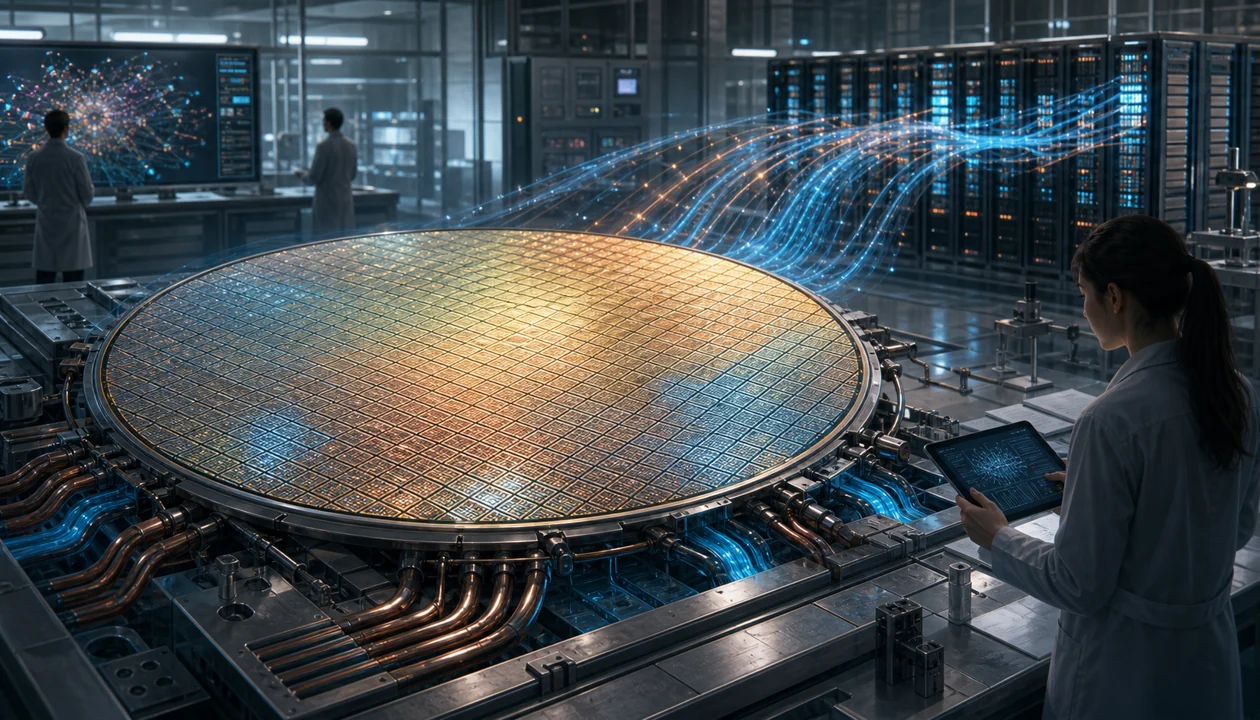
Cerebras Wafer-Scale Engine is not a desktop GPU. It is the compute foundation of a specialised AI infrastructure platform. Cerebras puts a very large number of compute elements and local memory on one wafer and combines that hardware with its own system and software layer. This matters when a team trains or serves large models and a conventional multi-GPU setup is limited by communication, memory placement or latency. For an occasional notebook experiment, the platform is usually more infrastructure than the job needs.
Who is Cerebras for?
The platform is aimed at research teams, model providers, cloud and data-centre operators, and organisations with recurring large training or inference workloads. The decision should start with a measurable bottleneck: distributed communication takes too long, the workload needs more contiguous memory, or inference latency and throughput have direct business value.
For local prototypes, small fine-tuning runs or irregular experiments, an accessible GPU or managed model API is often the more sensible starting point. Cerebras becomes relevant when the team can own the data pipeline, model operations, monitoring and a credible utilisation plan.
What is the technical idea?
The key difference from a conventional GPU cluster is the wafer-scale architecture: many compute elements and local memory share one very large processing unit. Cerebras presents systems such as the CS series, WSE hardware and software for training and inference as one platform. The practical capability therefore depends on the system, installed software and operating model, not on the chip name alone.
A project should evaluate three layers separately:
- the WSE hardware and its memory and communication design;
- the Cerebras system software, framework integration and model support;
- the delivery or cloud model through which the team actually consumes compute.
A realistic evaluation workflow
Start with an existing model and a reproducible dataset. First record the current GPU or cloud baseline: throughput, latency, memory use, error rate and total operating cost. Then port that same workload instead of choosing an impressive demo that does not match the production data path.
Next test data preparation, checkpointing, monitoring and rollback. For training, the team needs to know whether a failed run can resume reliably. For inference, measure waiting time, batching, peak load and hand-off to downstream systems. Only when those results improve under representative conditions should the platform enter a larger capacity plan.
Integration and operations
Cerebras fits best into a controlled MLOps chain: a repository and versioned data produce a reproducible run, the model is evaluated, an artefact is registered and inference is monitored. The team also needs a plan for framework compatibility, checkpoints, data transfer, access roles and returning to the previous platform.
This is not a plug-and-play replacement for a graphics card. Procurement, networking, cooling, data-centre operations or the provider contract can matter as much as raw compute. A team that only evaluates model code will underestimate data and platform operations.
Privacy, security and governance
Before a run, establish whether training data leaves the organisation, who can see logs and checkpoints, and how long artefacts are retained. For personal or confidential data, the pilot needs access separation, encryption, deletion rules and a documented approval path. Model weights and generated outputs may also contain sensitive information.
A benchmark without data classification is not a production approval. Every workload should have an owner, a target quality level, a stop condition and a documented fallback on the existing infrastructure.
Costs and boundaries
The platform is commonly accessed through a custom quote, system purchase or provider model. The total cost includes compute time, model porting, data movement, storage, networking, monitoring, support, utilisation and dependency on the chosen supply path. A strong peak result does not justify expensive capacity if it sits idle between runs.
The main boundary is specialisation. Not every model, library or custom operator will work without adaptation or deliver the same benefit. Before deciding, test the actual models, sequence lengths, batch sizes, checkpoint cycles and failure cases that matter to the project.
Editorial Assessment
Cerebras is a serious option for teams whose AI workloads are constrained by distributed memory, communication overhead or high inference demand, and that can carry a specialised platform operation. The right evidence is a comparison on the team’s own data, including porting effort, utilisation, recovery behaviour and total cost.
For small teams, irregular experiments or models with many unsupported custom components, an accessible GPU, a TPU cloud service or a managed API is usually a better first step. We would approve Cerebras only after a bounded, measurable pilot and would document the existing platform as an equally valid fallback.
Open frequently asked questions
FAQ
When is Cerebras worth comparing with a GPU cluster?
When a specific workload is limited by communication, memory or latency and a pilot on the team’s own data shows a durable advantage. A general wish for more compute is not enough.
Is the Wafer-Scale Engine a single graphics card?
No. It is the central processing element of a specialised system platform. Procurement, software, networking and operations have to be assessed as one package.
Can a small team test Cerebras?
That depends on the available provider or access model. A small team should first check whether a cloud route and a narrow model pilot are available before planning dedicated infrastructure.
What data should enter a pilot?
Start with approved or synthetic data. Personal and confidential data require a documented review of location, access, deletion, logs and contractual terms.
How do you compare Cerebras fairly with GPUs?
Use the same model, data and quality criteria. Include throughput, latency, porting work, recovery, utilisation, energy, provider costs and human operating effort in the comparison.
