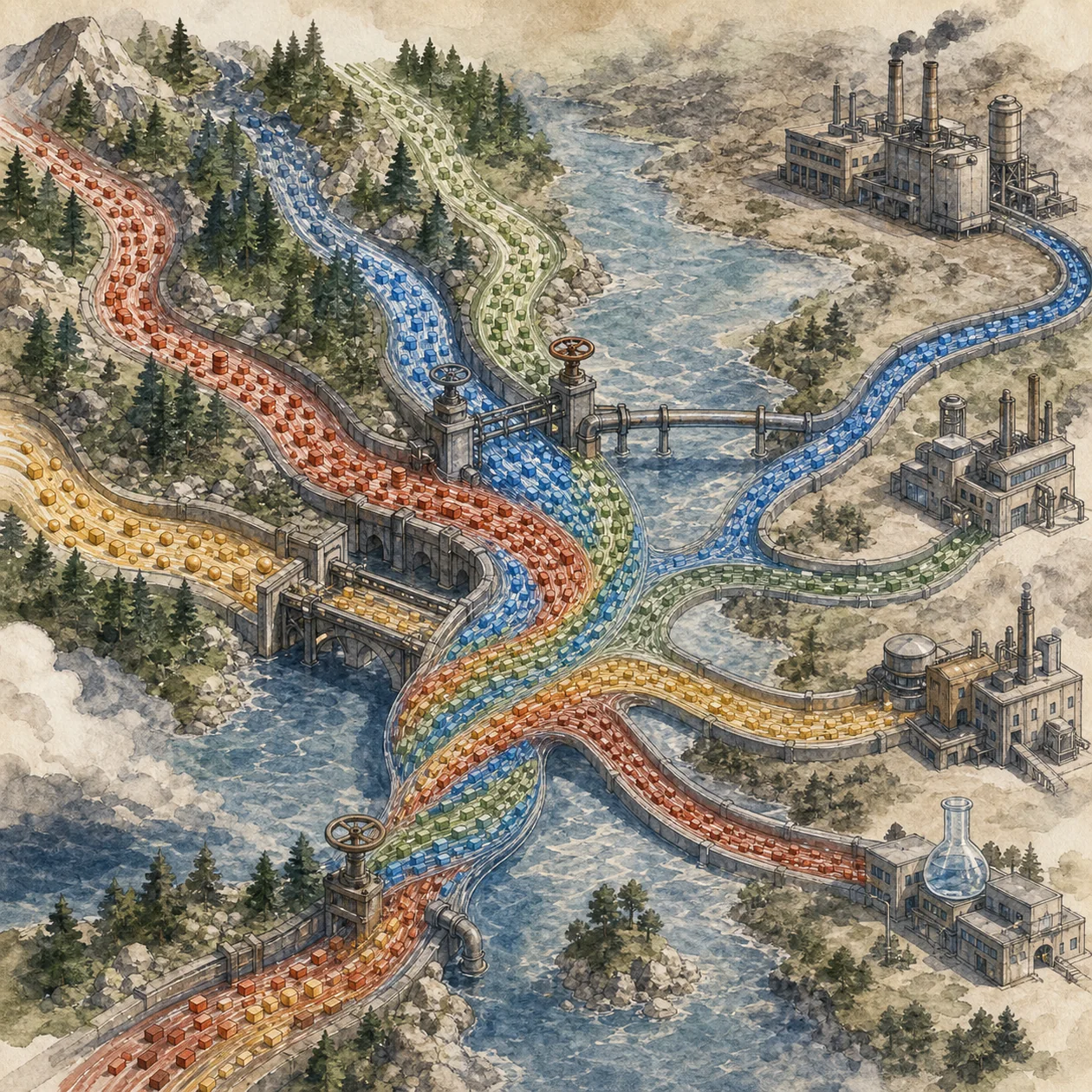
Confluent Platform is a self-managed distribution of Apache Kafka for event streaming in an organisation's own infrastructure. It moves events between producers and consumers and adds components for connectors, schemas, stream processing, and operations. That makes it an infrastructure decision for teams with a sustained streaming requirement, not a simple automation service for an isolated workflow.
What it is and who it is for
The platform fits data and platform teams that must distribute events from applications, databases, or devices: common examples include CDC pipelines, telemetry, fraud detection, inventory changes, and decoupled microservices. It is relevant when data locality, on-premises operation, or tightly controlled network boundaries matter. A team needs Kafka expertise or a realistic plan for on-call work, upgrades, and incident recovery.
For a small application with a few messages per day, this is usually excessive. The value appears when several systems need the same stream independently, replay matters, or a synchronous point-to-point integration has become too rigid.
Components in a real data flow
Apache Kafka provides the distributed log through topics, partitions, and consumer groups. Kafka Connect links external sources and sinks, while Schema Registry manages the evolution of data contracts. Kafka Streams and ksqlDB address transformations and stream processing; Control Center supports visibility and administration. Not every component has to be deployed, but its ownership and operating boundary should be documented before rollout.
The separation is useful: a source publishes a versioned event, several consumers read it at their own pace, and a sink processes it. It does not automatically prevent duplicates, ordering surprises, or business-level errors. Those behaviours must be handled in the event model and consumer implementation.
A practical rollout and operations workflow
- Select one meaningful stream and define its owner, retention, expected load, and recovery objective.
- Define the event schema, key, and compatibility rules; minimise personal or confidential fields before publication.
- Test producer, consumer, connector, and failure path in an isolated environment. Include restarts, backpressure, invalid messages, and a delayed consumer.
- Size partitions and replication from a load test, then configure alerts for consumer lag, broker health, disk pressure, and connector failures.
- Release production topics only after a documented restore, replay, and upgrade test. Give each stream an owner and a retirement rule.
Integration and quality checks
Kafka Connect is useful when sources and sinks should be attached through repeatable configuration rather than one-off scripts. For critical data, manage connector versions, configuration, and secrets reproducibly. A test should go beyond the happy path: check schema changes, replay, duplicate events, partial outages, and the effect of a bad consumer configuration.
Useful decision criteria include throughput and end-to-end latency, but also recovery time, consumer lag under load, error rate, and the effort required for a planned version change. A small proof of concept using production-like events is more informative than a benchmark based only on synthetic messages.
Security, privacy, and governance
With the self-managed model, the organisation remains responsible for the cluster, network, patches, backups, and access controls. Plan TLS, authentication, resource-level authorisation, secret management, and audit trails as part of the design. Topics are not a privacy boundary: retention, backups, replays, and connected sinks can keep personal data alive in more places.
Before go-live, document data classification, retention and deletion rules, encryption, operational access, and a process for schema changes. Also review the licence and support terms for the exact Platform version in use. Release notes and security advisories belong in the normal upgrade process.
Cost and ongoing effort
The cost is not limited to a possible Confluent contract. Platform also requires broker infrastructure, storage, network capacity, backups, and monitoring, plus staff time for on-call operations, capacity planning, connectors, upgrades, and incident response. Commercial entitlements and support depend on the edition and negotiated agreement; the current Confluent pricing and commercial page is authoritative before purchase.
Build a total-cost comparison over at least one operating cycle: cluster size, growth, retention, replication, test environments, and on-call coverage. A low initial licence cost can still become more expensive than a managed service once permanent platform expertise is included.
Editorial Assessment
We recommend Confluent Platform to data and platform teams that need to decouple several systems through durable event streams and deliberately choose self-managed operation for compliance, network, or architecture reasons. It creates value when there is a clear data contract, several real consumers, and a funded operating model.
For one integration job, light traffic, or a team without Kafka on-call capability, it is not the best first choice. A managed streaming service or narrower messaging product is often more sensible. The decision should rest on tested replay, failure recovery, and upgrade work—not on the length of the component list.
Open frequently asked questions
FAQ
Do I need Kafka expertise to run Confluent Platform?
Yes, at least for production operation. The team must understand topics, partitions, consumer groups, replication, lag, and recovery; the additional components do not replace those fundamentals.
Is Confluent Platform the same as Confluent Cloud?
No. Platform is the self-managed distribution for your infrastructure. Confluent Cloud is the managed-service approach. Compare operational responsibility, networking, data location, and contract model separately.
How do I prevent a broken consumer from losing data?
Define retention and replay procedures, monitor lag and errors, test restarts, and make processing idempotent. A backup alone is not a controlled consumer recovery plan.
Can personal data be sent through Kafka?
Technically yes, but that does not make the processing compliant. Assess and document minimisation, access, encryption, retention, backups, sinks, and deletion before moving such data into the stream.
When is a managed service the better choice?
When the team does not want permanent responsibility for cluster operations, patches, capacity, and on-call response. The comparison should include staff time and outage risk, not only licence or service pricing.