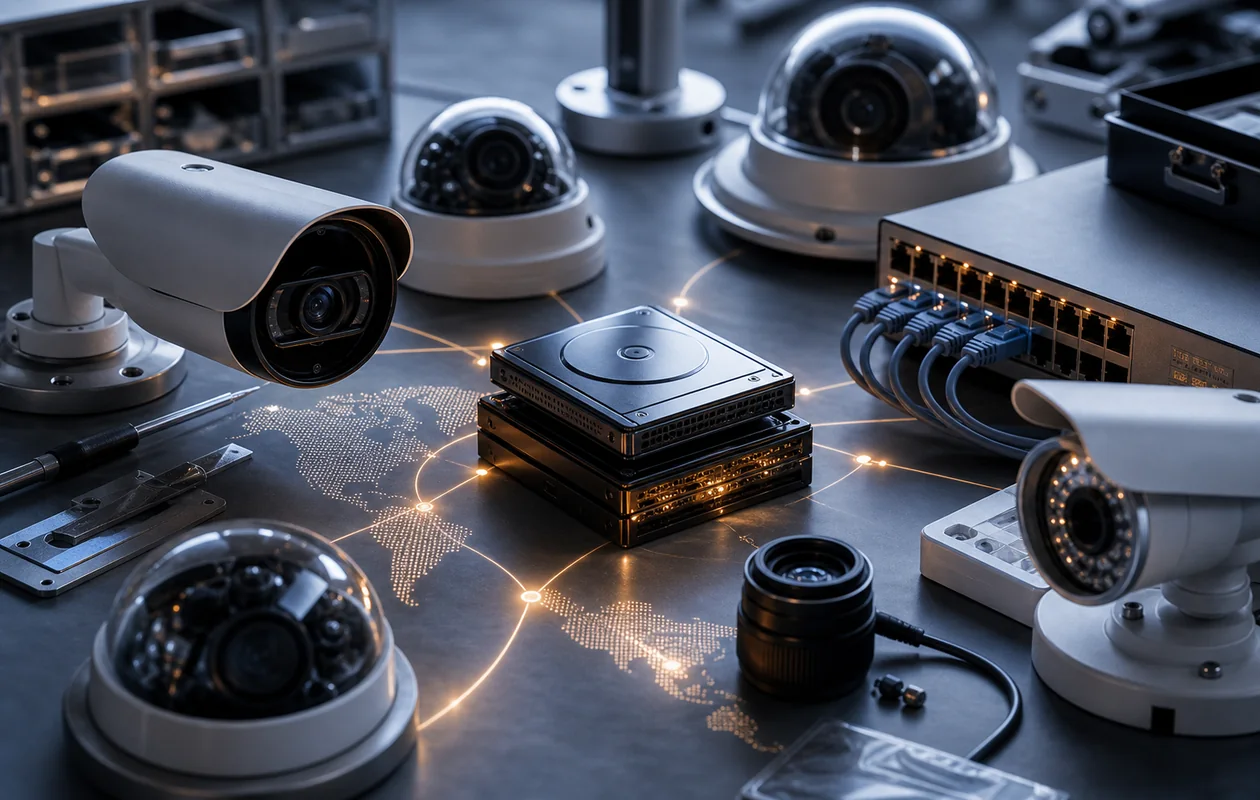
Dahua Technology is a leading provider of video surveillance and security solutions. The company offers a broad range of hardware and software products that combine modern video analysis, intelligent monitoring, and reliable security features. Dahua targets businesses and organizations that require robust and scalable video surveillance systems to effectively protect their assets and staff.
Who is Dahua Technology suitable for?
Dahua Technology is especially suitable for companies, government agencies, and institutions that require comprehensive security solutions. These include retail stores, office buildings, industrial facilities, public institutions, and residential complexes. The systems are suitable for both small and large installations and offer flexible customization options according to security requirements. Integrators and IT professionals also benefit from the compatibility and diverse functions of Dahua products.
Typical Use Cases
- Operating video surveillance: Dahua Technology is relevant for sites where cameras, recorders, and video analytics are planned together.
- Security and facility teams: The systems fit organizations that need ongoing monitoring of access, premises, and incidents.
- Hardware-heavy projects: Planning, installation, networking, and maintenance matter as much as software features.
What really matters in daily use
With Dahua Technology, daily value is determined not only by camera images but by operations, permissions, and response paths. Good image quality is not enough if recordings are hard to find, alarms are misconfigured, or no one owns maintenance and updates.
Before deployment, teams should test real scenarios: night images, backlight, network stability, storage needs, and security staff access. That shows whether the system supports the site or merely adds more technology to manage.
Key Features
- High-resolution IP and analog cameras with various lens types
- Intelligent video analytics such as motion detection, facial recognition, and license plate recognition
- Network Video Recorders (NVR) and Digital Video Recorders (DVR) for storage and management
- Remote access and monitoring via mobile apps and web browsers
- Scalable system architecture for installations of all sizes
- Integration with other security and building management systems
- Support for cloud services for storage and analysis (depending on plan)
- Real-time alerting and event notifications
- Various security protocols and encryption technologies
- User-friendly management software for system configuration and reporting
Advantages and Disadvantages
Advantages
- Comprehensive product portfolio from cameras to complete solutions
- Advanced video analytics to automate security processes
- High flexibility and scalability
- Support for modern network standards and cloud integration
- Regular software updates and continuous development
- Professional support and extensive documentation
Disadvantages
- System complexity may be challenging for beginners
- Subscription-based pricing can become costly depending on the plan
- Some features are only available in higher-tier packages or with additional hardware
- Installation and optimal configuration require technical expertise
Workflow Fit
Dahua systems belong in a clear security workflow: detect an event, review footage, document the incident, and share it when needed. Interfaces to access control, control rooms, or archives should be tested early. Multi-site setups need consistent naming rules and maintenance windows.
Data Protection & Data
Video surveillance processes highly sensitive personal data. Camera locations, notices, retention periods, access rights, and export processes must be clarified legally and operationally. Firmware updates, network segmentation, and remote access should also be treated as core security topics.
Editorial Assessment
Dahua Technology can be capable in professional security projects, but it requires a sober review of privacy, IT security, and operations. Buying cameras alone rarely solves the real problem. The decisive factor is a controlled setup across hardware, network, roles, and processes.
Pricing & Costs
Dahua Technology primarily offers its products and services on a subscription basis. Exact costs vary depending on the selected product package, number of cameras, storage requirements, and additional software modules. Some basic features may be free or available as freemium versions depending on the provider or plan, while advanced analytics and cloud storage are typically paid. Customized quotes are common for individual needs and larger projects.
Open frequently asked questions
FAQ
1. What types of cameras does Dahua Technology offer?
What should a Dahua Technology pilot look like?
Start with a bounded process, a small group and a clear success criterion. Check output quality, permissions and handovers before expanding the scope.
Which data should not be processed in Dahua Technology without review?
Sensitive or confidential content should wait until contract terms, access, storage and deletion controls have been reviewed. Escalate uncertainty to the responsible privacy owner.
When is an alternative to Dahua Technology the better choice?
Choose an alternative when the need is occasional, a required integration is missing, or administration and cost outweigh the practical benefit.
Dahua offers both IP and analog cameras in various form factors such as dome, bullet, and PTZ, suitable for different applications.
2. Can I connect Dahua systems with other security solutions? Yes, Dahua supports integration with various security and building management systems via standardized interfaces.
3. Is there a mobile app for remote monitoring? Yes, Dahua provides apps for iOS and Android that allow users to monitor their cameras and recordings anytime, anywhere.
4. What analytics functions are available? Features include motion detection, facial recognition, license plate recognition, person and object detection, and other intelligent alerts.
5. How secure is the data with Dahua? Dahua employs encryption technologies and security protocols to ensure data protection during transmission and storage.
6. Is cloud storage possible? Depending on the plan and product, cloud storage can be used to securely archive recordings and access them from multiple locations.
7. Do I need technical knowledge for installation? Basic systems can usually be installed by tech-savvy users, but more complex installations should be handled by professionals.
8. How is pricing structured? Pricing is based on a subscription model and depends on the number of cameras, storage needs, and additional features. Customized offers are available.