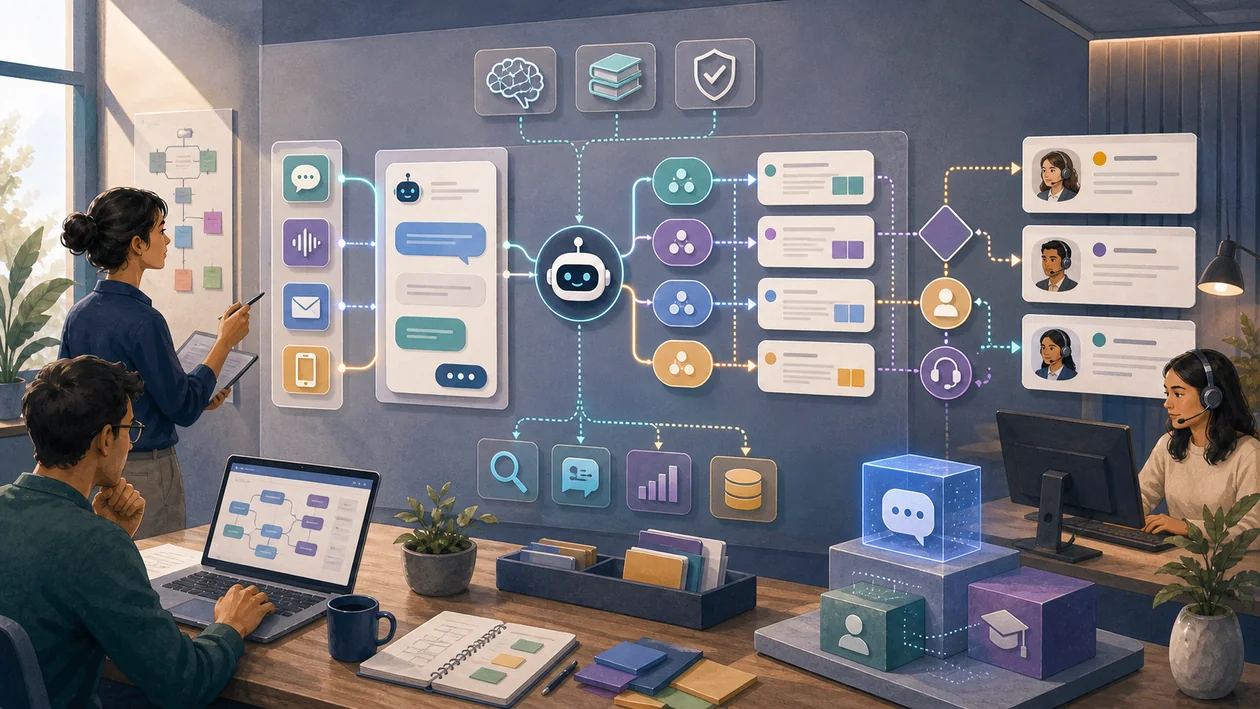
IBM Watson Assistant is an advanced AI-based platform for creating chatbots and virtual assistants. It enables companies to develop intuitive, context-aware dialog systems that handle customer inquiries automatically and efficiently. With Watson Assistant, you can design complex interactions that go beyond simple responses and are continuously improved through machine learning.
Who is IBM Watson Assistant suitable for?
IBM Watson Assistant is aimed at companies and developers who want to implement powerful, customizable chatbots or virtual assistants. The platform is especially suitable for:
- Mid-sized and large companies that want to automate customer service
- Developers and IT teams that want to integrate flexible AI solutions into existing systems
- Industries such as financial services, retail, telecommunications, and healthcare that handle complex customer inquiries
- Organizations that want to support multichannel communication (web, mobile, messaging platforms)
The platform is suitable both for technical users with programming knowledge and for business users who want to create simple chatbots through a graphical user interface.
Key features
- Natural Language Processing (NLP): Understands user requests in natural language and interprets intents and entities.
- Dialog management: Enables the design of complex, context-dependent conversation flows.
- Multichannel support: Integration into websites, mobile apps, messaging services such as WhatsApp, Slack, and more.
- Machine learning: Automatic improvement of responses through training with real conversations.
- Templates and tools: Prebuilt templates for various industries and use cases.
- Analytics and reporting: Detailed analysis of user interactions to optimize the assistant.
- Integration: Interfaces to backend systems, CRM, databases, and other IBM Cloud services.
- Voice and text support: Support for multiple languages and both text-based and voice-based interactions.
- Security features: Data protection and compliance for sensitive business data.
Pros and cons
Pros
- Powerful AI technology with high-quality language understanding
- Flexible adaptation to different use cases and platforms
- Extensive documentation and community support
- Integration into the IBM Cloud ecosystem with additional AI and analytics tools
- Freemium model allows getting started without immediate costs
- Scalable from small projects to large enterprise applications
Cons
- The platform's complexity can mean a steep learning curve for beginners
- Some advanced features are only available in paid plans
- User interface and terminology are partly technical and less intuitive for non-developers
- Dependence on IBM Cloud can make integration into other cloud environments more difficult
What really matters in daily use
IBM Watson Assistant can look useful quickly, but daily work asks a sharper question: does chatbot and service dialogues for enterprises with controlled processes fit existing data, roles and approvals? Good evaluation means real trials with real intents, escalations, knowledge sources and service metrics, not just a quick look at example outputs. The important constraint is: helps structured support, but weak processes become more visible through a bot.
Workflow Fit
For teams, IBM Watson Assistant should not start as a loose side tool; it should attach to a repeatable step in the process. When chatbot and service dialogues for enterprises with controlled processes happens often, a small pilot makes visible how much control and cleanup are really needed. The evidence should come from real trials with real intents, escalations, knowledge sources and service metrics. That keeps a strong first impression from becoming operational drag later.
Editorial Assessment
Our assessment: IBM Watson Assistant is strongest when benefits, limits and owners are named before the test starts. The decision should consider cost, quality and controllability together. Helps structured support, but weak processes become more visible through a bot. Otherwise the tool can look more valuable than the real process gain proves to be.
Pricing & costs
IBM Watson Assistant offers a freemium pricing model that allows for a free entry point. The exact costs vary depending on usage, feature scope, and the selected plan. Paid plans typically include:
- A higher number of users and requests per month
- Access to advanced AI features and integrations
- Priority support and service-level agreements (SLAs)
- Company-specific customization and security features
For exact pricing information, it is recommended to consult the official IBM website or contact a sales representative directly.
Open frequently asked questions
FAQ
1. Can IBM Watson Assistant be used without programming knowledge?
What should a IBM Watson Assistant pilot look like?
Start with a bounded process, a small group and a clear success criterion. Check output quality, permissions and handovers before expanding the scope.
Which data should not be processed in IBM Watson Assistant without review?
Sensitive or confidential content should wait until contract terms, access, storage and deletion controls have been reviewed. Escalate uncertainty to the responsible privacy owner.
When is an alternative to IBM Watson Assistant the better choice?
Choose an alternative when the need is occasional, a required integration is missing, or administration and cost outweigh the practical benefit.
Yes, the platform offers a graphical user interface that allows users without deep programming knowledge to create simple chatbots. However, technical knowledge is helpful for more complex customizations.
2. Which languages does IBM Watson Assistant support? Watson Assistant supports multiple languages, including German, English, Spanish, French, and others. The exact language coverage may vary depending on the plan and region.
3. Can IBM Watson Assistant be integrated into existing systems? Yes, the platform provides APIs and interfaces to integrate chatbots into websites, mobile apps, CRM systems, and other backend solutions.
4. How secure is the data in IBM Watson Assistant? IBM places great emphasis on data protection and compliance. The platform meets industry-standard security requirements and offers features for data encryption and access control.
5. Is there a free trial? Yes, the freemium model allows a free start with limited functionality so you can test the platform before using a paid plan.
6. How does IBM Watson Assistant scale as the number of users grows? The platform is cloud-based and scalable, so it can handle both small and very large numbers of users and requests, depending on the selected plan.
7. Which industries benefit especially from IBM Watson Assistant? In particular, financial services, retail, telecommunications, healthcare, and other service-oriented industries use Watson Assistant for automated customer interaction.
8. How can I reach support if I have problems? Support options depend on the selected plan and range from community forums and documentation to professional support with service-level agreements.