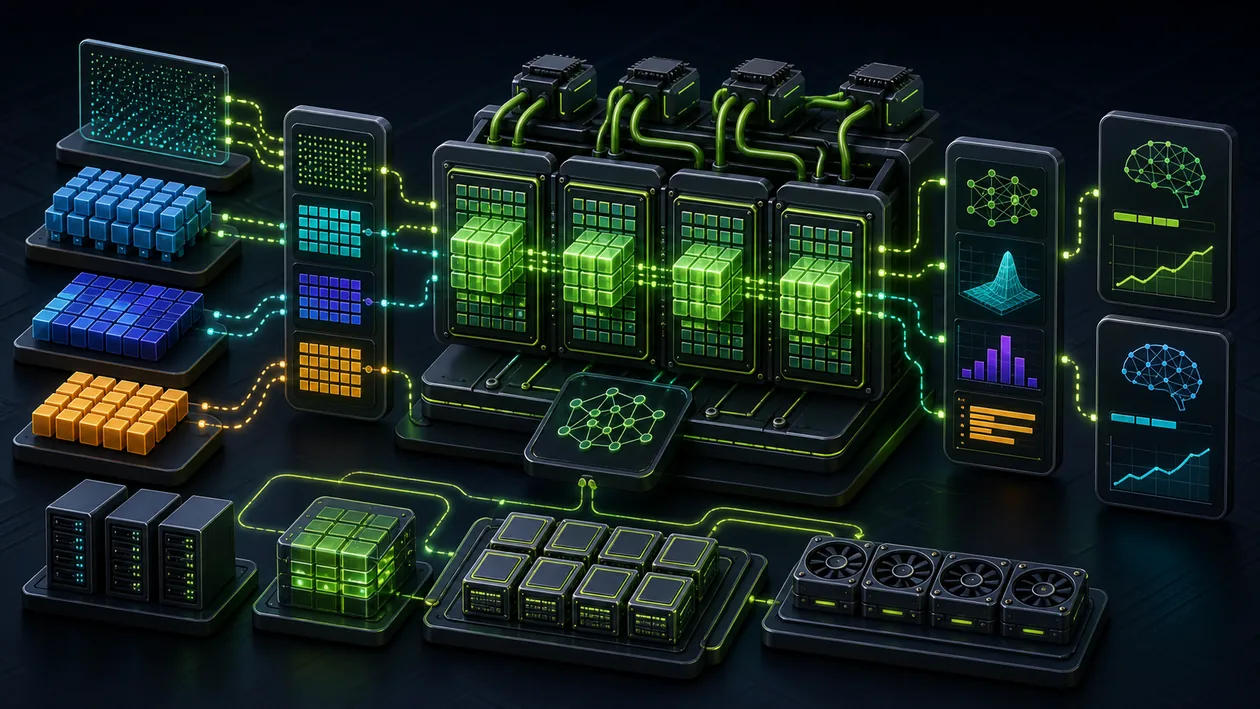
NVIDIA Tensor Core GPUs are a family of GPU accelerators for machine learning, scientific computing and other heavily parallel workloads. Tensor Cores execute matrix operations in optimised numerical formats, while CUDA cores, memory, drivers and libraries complete the compute path. That matters when training or inference is genuinely waiting on GPU mathematics. It is not a blanket performance promise: the generation, memory, model shape, batch behaviour and software determine whether the benefit reaches the real workflow.
Who are they for?
These GPUs fit ML and platform teams, research groups, computer vision, speech and generative AI projects, and HPC workloads with recurring compute demand. They are most defensible when a team trains its own models, runs reproducible fine-tuning or operates an inference service with measurable load.
For a small notebook, occasional API calls or ordinary web development, owning a Tensor Core GPU is often the wrong first investment. A rented GPU, managed service or CPU baseline may be easier to operate. The decision should begin with a proven bottleneck, not with an architecture name.
What do Tensor Cores contribute?
Tensor Cores are not a complete platform, and they are not identical across generations. They accelerate matrix multiply-accumulate operations found in many neural networks. Depending on the GPU, relevant modes can include FP16, BF16, TF32, FP8 or integer formats. Lower precision can reduce memory use and compute time, but it has to be checked against model quality and numerical stability.
In practice, four layers matter: the GPU generation and memory, CUDA and the driver, libraries such as cuBLAS, cuDNN or NCCL, and the chosen framework and model. NVLink or multiple GPUs can support scaling, but they do not automatically remove data-pipeline, networking, synchronisation or memory bottlenecks.
A realistic starting workflow
Start with an existing model, a fixed dataset and a CPU or current-GPU baseline. Measure end-to-end time, throughput, peak memory, utilisation, error rate and output quality. A synthetic benchmark can supplement the test, but should not replace the production decision.
Then run a small mixed-precision trial. Compare the learning curve, convergence and inference quality with the reference, and record which operators actually use Tensor Core paths. For multi-GPU work, add communication, checkpoint and recovery measurements. Only after the model runs reproducibly should the team choose a larger card or instance.
Integration and operations
A usable environment needs a compatible NVIDIA driver, CUDA versions, framework releases and reproducible build or container definitions. NVIDIA NGC can provide GPU-optimised containers, but it does not remove the need to check image tags, security approval, driver boundaries and local dependencies. For a service, the model artefact, preprocessing, batching, monitoring and rollback belong to the same design.
In ongoing operation, monitor GPU memory, temperature, utilisation, queue time, errors, power and cost. For multi-GPU training, test data parallelism, communication and checkpointing. A card that is fast in a kernel benchmark can remain idle in the real system because data delivery is slow or batches are too small.
Quality, security and governance
Before the pilot, define data classes, storage locations, access roles, log contents and deletion periods. Training data, checkpoints, model weights and outputs may be confidential. With cloud GPUs, also review the provider contract, network path, encryption and whether data leaves the organisation.
Evaluation needs a frozen test set, domain-specific error thresholds and a documented fallback. Mixed precision is successful only when quality and stability remain within the accepted limits. Version drivers, containers and CUDA, and run a small regression test before upgrades.
Costs and limitations
Total cost is more than the GPU purchase or rental. Consider GPU memory and count, runtime, utilisation, power, cooling, server hardware, storage, networking, data transfer, support, replacement and the engineering time required for CUDA and driver maintenance. Cloud usage moves the purchase into usage-based spending, but idle time, storage and egress still matter.
The main limitation is specialisation. Not every operation is accelerated, and not every model benefits equally from lower precision. Older and newer generations differ in formats and software support. A fair comparison must name the actual GPU, driver, framework, batch size and quality result.
Editorial Assessment
I recommend NVIDIA Tensor Core GPUs to teams with recurring training or inference jobs, a measurable GPU bottleneck and the ability to operate drivers, data pipelines and evaluation. Value exists when a test on representative data produces durable end-to-end gains and utilisation justifies the infrastructure.
For irregular experiments, small models or teams without platform ownership, a single workstation GPU, a cloud accelerator or a managed option is usually more sensible. We would require a bounded baseline pilot with a quality threshold, cost model and fallback before approving a purchase.
Open frequently asked questions
FAQ
Do I need Tensor Cores for machine learning?
No. Many models also run on CPUs or GPUs without these units. Tensor Cores become relevant when matrix operations take a meaningful share of runtime and the specific precision and framework can use them.
Are all NVIDIA Tensor Core GPUs equally suitable?
No. Generation, memory, supported formats, drivers and cooling differ. Compare the specific card with the actual model and batch workload rather than relying on the family name.
Can mixed precision reduce model quality?
Yes. Training or inference must be evaluated against a reference; sensitive operations may need higher precision. A fast run without a quality check is not a successful pilot.
When is renting better than buying?
Renting is often sensible for irregular jobs, uncertain demand or teams without server and cooling infrastructure. Buying can work at predictable high utilisation when operations, replacement and software maintenance are included in the calculation.
What data can I process on a GPU?
That depends on the environment, contract and protection level. Approved or synthetic data is safer for an initial test; personal or confidential data requires a review of access, logs, location, encryption and deletion.