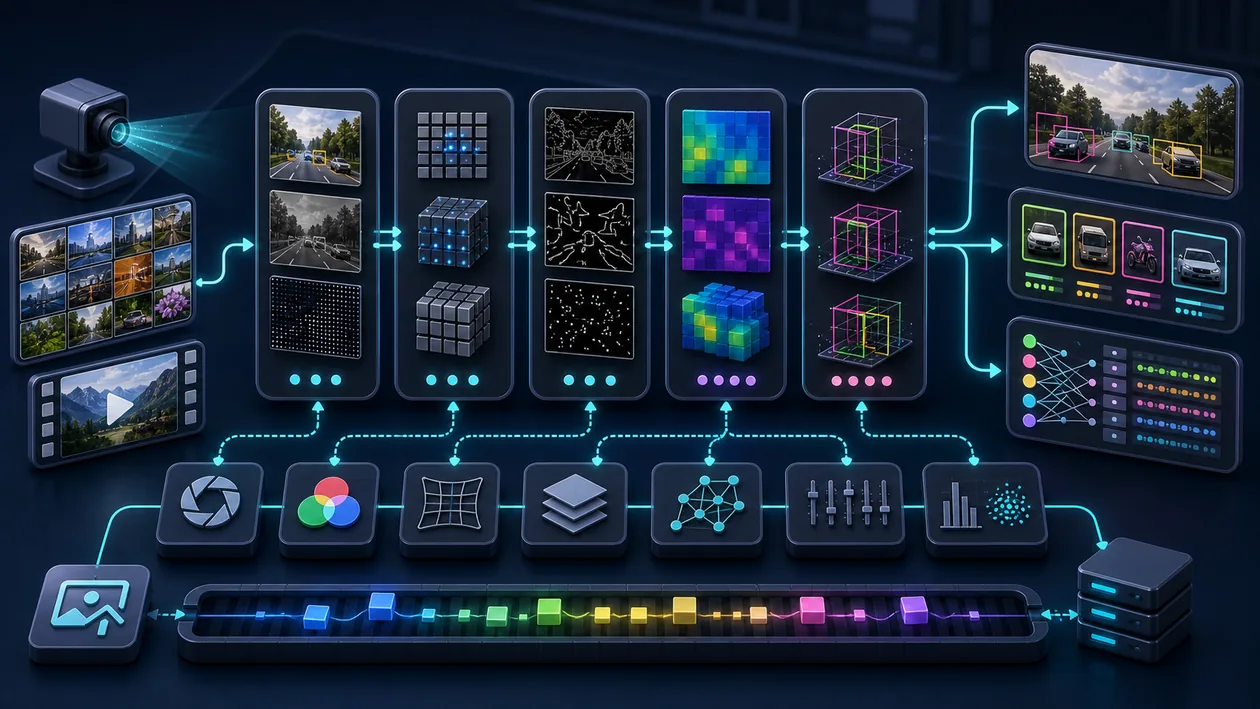
OpenCV is better understood less as a feature list and more as a concrete workflow: a computer vision library for image and video processing. Its practical value lies in building prototypes and production vision pipelines on a solid foundation without outsourcing every decision to side tools.
For evaluation, the key question is which accuracy, runtime, and hardware environment are realistic. If that point remains unresolved, even a strong tool can quickly appear larger than its actual benefit.
Who is OpenCV suitable for?
OpenCV is a good fit for development teams with their own CV models, camera data, or edge projects. If you only need a quick one-off action, keep the effort small and first check which accuracy, runtime, and hardware environment are realistic.
It is less suitable when this point of caution already becomes visible in the pilot: it remains hard to access without ML and image processing knowledge. In such cases, a leaner process is often more sensible than a major platform decision.
Editorial assessment
OpenCV is convincing not because it offers as many options as possible, but when the core process is cleanly structured. A good test starts with a typical case from your own daily work and a clear criterion for when the result is good enough.
- Strong use case: for development teams with their own CV models, camera data, or edge projects.
- Clarify first: which accuracy, runtime, and hardware environment are realistic.
- Do not underestimate: it remains hard to access without ML and image processing knowledge.
Main features
Image and video processing (filters, transformations, edge detection)
Object detection and tracking (Haar cascades, HOG, deep learning models)
Face recognition and verification
3D reconstruction and stereo vision
Machine learning and deep learning integration (supports frameworks such as TensorFlow, Caffe)
Camera calibration and image rectification
Real-time video analysis and processing
Support for numerous image formats and platforms
Practical check: which accuracy, runtime, and hardware environment are realistic.
Team adoption: building prototypes and productive vision pipelines on a solid foundation.
Pros and Cons
Pros
- Open source and free to use (freemium model with optional add-ons)
- Extensive documentation and a large community
- Cross-platform (Windows, Linux, macOS, Android, iOS)
- Supports various programming languages
- Flexible for simple to complex projects
- Regular updates and extensions
- Particularly valuable: for development teams with their own CV models, camera data, or edge projects.
Cons
- The learning curve for beginners can be steep
- For very specialized or highly complex applications, additional tools may be needed
- Documentation can be difficult to navigate in places
- Performance optimizations often require deeper technical knowledge
- Point of caution: it remains hard to access without ML and image processing knowledge.
Pricing & Costs
OpenCV is generally free to use as an open-source library. However, there are commercial vendors and platforms that offer extended solutions or support based on OpenCV. Prices vary depending on the provider, license model, and scope of support. For many users, the free base library is sufficient to build professional applications.
For budget planning, OpenCV should not be evaluated only by list price. More important are operating costs, training, integrations, and the question of which accuracy, runtime, and hardware environment are realistic.
Open frequently asked questions
FAQ
1. Is OpenCV free?
What should a OpenCV pilot look like?
Start with a bounded process, a small group and a clear success criterion. Check output quality, permissions and handovers before expanding the scope.
Which data should not be processed in OpenCV without review?
Sensitive or confidential content should wait until contract terms, access, storage and deletion controls have been reviewed. Escalate uncertainty to the responsible privacy owner.
When is an alternative to OpenCV the better choice?
Choose an alternative when the need is occasional, a required integration is missing, or administration and cost outweigh the practical benefit.
Yes, the OpenCV library is open source and can be used for free. However, there are paid offerings based on OpenCV that provide additional support.
2. Which programming languages are supported? OpenCV mainly supports C++, Python, and Java, and some functions are also available in other languages.
3. Can OpenCV be used for real-time applications? Yes, OpenCV is optimized for real-time image and video processing and is used in many applications with real-time requirements.
4. Do I need prior knowledge of AI to use OpenCV? Basic programming knowledge is required, and for complex AI applications, knowledge of machine learning is also helpful.
5. Which platforms does OpenCV run on? OpenCV is cross-platform and runs on Windows, Linux, macOS, as well as mobile operating systems such as Android and iOS.
6. Is there an active community or support? Yes, OpenCV has a large developer community, numerous forums, and extensive documentation.
7. How can I integrate OpenCV into my projects? OpenCV can be integrated as a library into various development environments, depending on the programming language used.
8. What kinds of applications can be built with OpenCV? From simple image editing to object detection and complex AI-driven systems such as autonomous driving or medical image analysis, many things are possible.
9. How should OpenCV be tested? Best with a small, real scenario from your own daily work. You should check whether the tool helps build prototypes and productive vision pipelines on a solid foundation, and whether the results are usable without much rework.
10. What is the most common stumbling block with OpenCV? The most common stumbling block is starting too broadly. Before rollout, it should be clear which accuracy, runtime, and hardware environment are realistic; otherwise, the benefit is hard to assess.
Workflow and rollout
A useful start with OpenCV begins with one concrete workflow and a small user group. Define the input, expected outcome and manual checkpoint before adding more automation or permissions. Record who approves the result and how a failed step is reversed. A focused pilot makes it clear whether OpenCV holds up in daily work or only looks convincing in a demo.