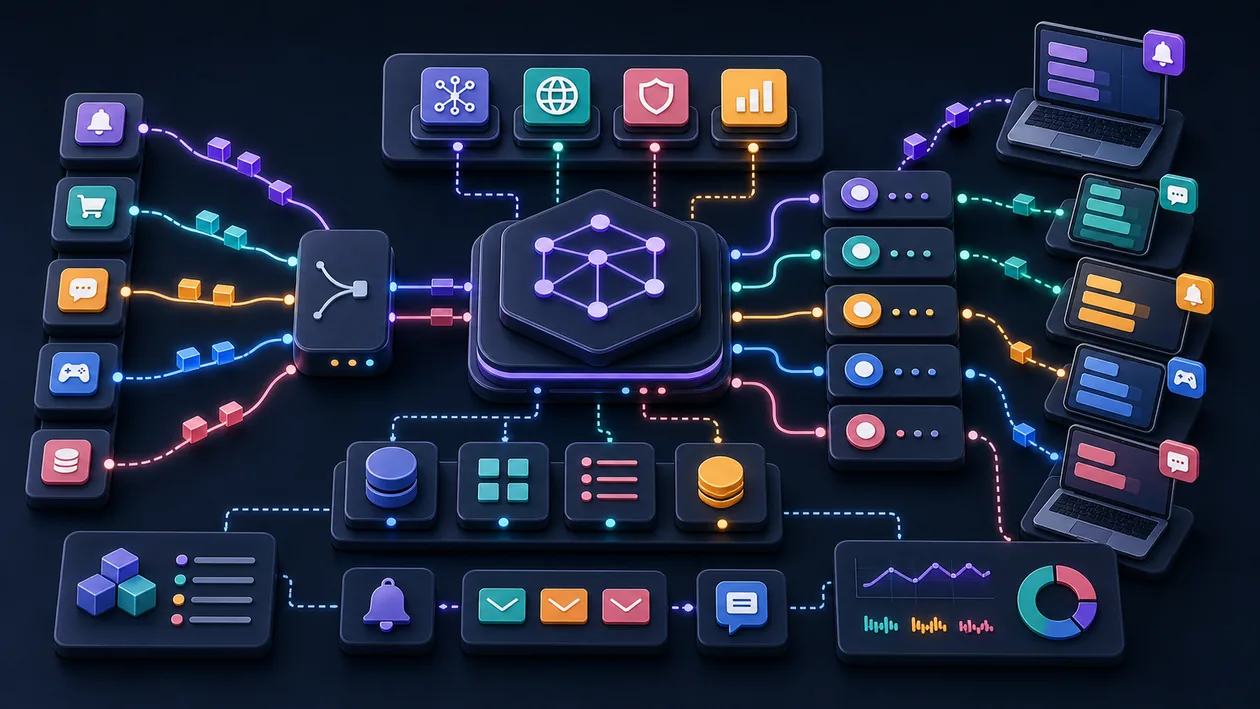
Pusher is a hosted service for realtime events in web and mobile applications. Instead of building and scaling WebSocket infrastructure, backend services publish events to channels and connected clients receive them immediately. Common uses include notifications, live dashboards, chat, collaboration, and status indicators.
Who is Pusher for?
Pusher fits product teams needing fast realtime features without operating their own messaging cluster. It is particularly appropriate for clear UI events: an order changes status, a support ticket gets a message, or a colleague edits a document. For durable business processes, however, Pusher replaces neither a queue nor a reliable database.
The right architectural model
An event should announce a change rather than define state by itself. After receiving it, a client can load the authoritative state from an API. That handles lost connections, duplicate events, and delayed messages. An order must not be treated as paid simply because one browser saw an event.
Channels, authentication, and presence
Public channels suit non-sensitive information. Private and presence channels need server-side authorisation: the server must verify that a user may see exactly that room, ticket, or project. Presence is useful for “who is online,” but should not be confused with a security or audit log.
Reliability and operations
Plan for reconnects, idempotent event handling, ordering, and fallback polling. A client can be offline or receive a message twice. Give events traceable IDs and measure connections, errors, latency, and peak load. A load test with realistic concurrent sessions is more useful than one local browser.
Cost and privacy
The freemium/usage model normally depends on connections, messages, and product capabilities. Model peaks, not averages alone. Do not send unnecessary personal content or tokens in event payloads; they may appear in browser logs, monitoring, or third-party infrastructure. Sensitive applications require review of data flow, retention, and processing terms.
Editorial assessment
Pusher is a sound shortcut to realtime UX when a team clearly separates an event signal from the business source of truth. It saves infrastructure work, not responsibility for authorisation, reconnection, and cost control. Begin with one private channel and an authoritative API before rolling out chat or collaborative screens widely.
Open frequently asked questions
FAQ
Does Pusher replace a database or message queue?
No. Pusher delivers events to clients. Persistent business processes and reliable processing belong in a database, queue, or backend service.
How should private realtime data be protected?
Use server-side channel authorisation and minimal payloads. The browser must not decide which private channels it can subscribe to.
When is self-hosting a better fit?
When special data residency, unusually high load, custom protocol requirements, or an existing operations team justify the additional work.