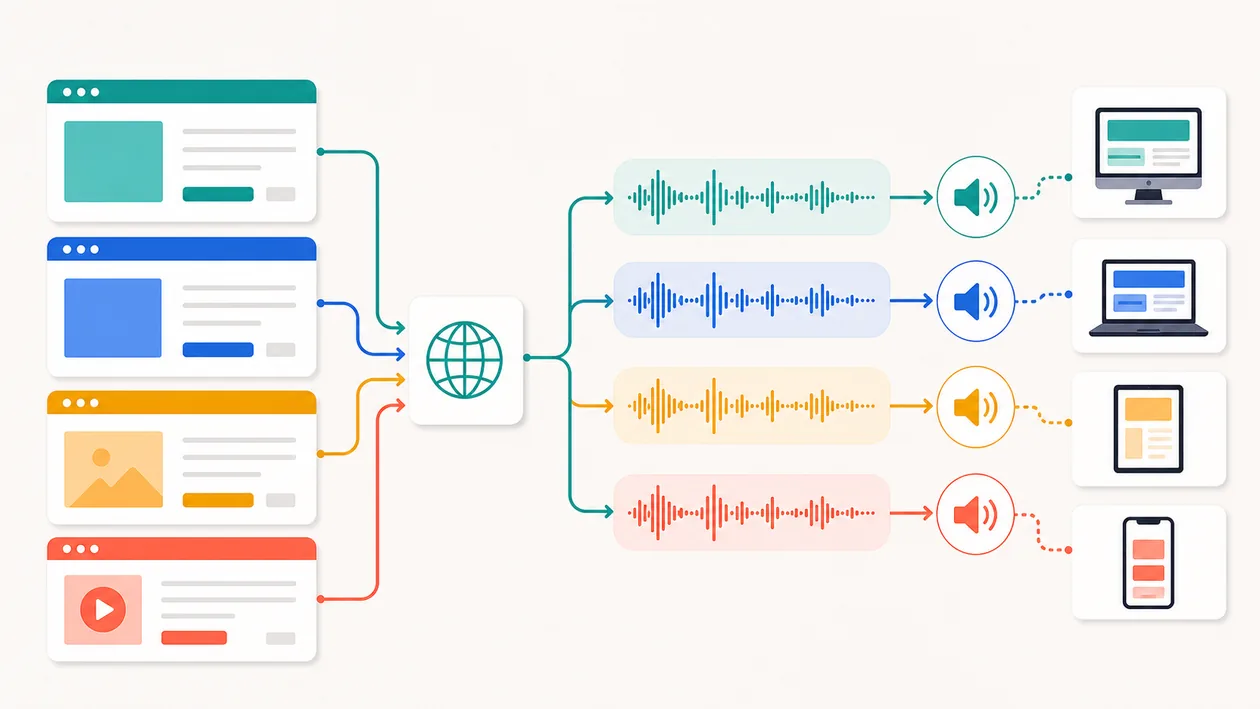
ResponsiveVoice is an AI-powered text-to-speech solution that enables simple integration of voice output into websites and applications. The technology supports numerous languages and voices, allowing users to make their content accessible and interactive. ResponsiveVoice is especially suitable for developers, content creators, and businesses that want to extend their digital products with natural-sounding speech output.
Who is ResponsiveVoice suitable for?
ResponsiveVoice is aimed at web developers, e-learning providers, companies in the accessibility space, and content managers who want to improve their workflow with automated speech output. Small and medium-sized businesses that want to create audio content without major technical effort also benefit from the simple integration. Thanks to broad language support, the tool is suitable for international projects and multilingual websites.
A small, bounded test is usually enough to learn whether ResponsiveVoice fits. It should show whether response time, handoff quality, and customer satisfaction improve without creating new shadow processes.
The first test for ResponsiveVoice should stay deliberately narrow: one process, one owner, a before-and-after comparison, and a short retrospective.
Editorial assessment
ResponsiveVoice can be useful when it is embedded in a clear process. Without ownership and review rules, the value can remain vague even if the product looks convincing in a demo.
A useful evaluation starts with a real service case with intake, prioritization, response, escalation, and follow-up. Only then can a team decide whether ResponsiveVoice is just a nice add-on or a dependable part of the workflow.
- What to watch: With ResponsiveVoice, response time, handoff quality, and customer satisfaction should be checked against concrete before-and-after evidence, not only against first impressions.
- Good starting point: Test ResponsiveVoice in one real workflow where input, output, and review are described before the first run.
- Common pitfall: ResponsiveVoice disappoints when channels, ownership, and escalation rules are not clearly defined.
Main features
Real-time text-to-speech conversion directly in the browser
Support for more than 50 languages and various voices
Adjustable speaking speed and volume
Compatibility with all modern web browsers without additional plugins
Easy embedding via JavaScript API or HTML attributes
Accessibility features to support users with visual impairments
Offline mode available in certain plans
Automatic language detection based on the text content
Integration with various CMS and e-learning platforms
Workflow optimization through simple automation of audio output
Practical workflow: ResponsiveVoice should be tested against a real service case with intake, prioritization, response, escalation, and follow-up, not only against a polished demo.
Quality control: ResponsiveVoice becomes stronger when response time, handoff quality, and customer satisfaction move from gut feeling into a reviewable process.
Team handoff: ResponsiveVoice becomes more useful when outputs, decisions, and open questions remain understandable for other roles.
Pros and cons
Pros
Easy integration without complex programming
Wide selection of languages and voices
Usable across platforms, no installation required
Improves the accessibility of websites and applications
Flexible options for adjusting voice characteristics
Fast and reliable real-time speech output
Stronger in daily work when ResponsiveVoice is used for clearly bounded tasks rather than every possible side problem.
Does more than add convenience when ResponsiveVoice turns customer communication, availability, and clean handoffs between channels from personal notes into a shared workflow.
Cons
Costs may apply depending on usage, especially in commercial scenarios
Voice quality varies by language and voice
Advanced features may require technical know-how
Offline functionality is not available in all plans
No full control over voice design compared with highly specialized TTS systems
Can create additional coordination work when ResponsiveVoice is introduced before channels, ownership, and escalation rules are not clearly defined and nobody owns the open questions.
Without maintained ownership, ResponsiveVoice can remain another available tool rather than a reliable team routine.
Pricing & costs
ResponsiveVoice pricing depends on the chosen plan and usage volume. There is usually a free version with limited features and usage caps, ideal for testing and small projects. Paid plans are available for professional and commercial applications and offer advanced features, higher usage limits, and support. Pricing details vary by provider and should be checked directly on the ResponsiveVoice website.
Beyond the list price, ResponsiveVoice should be evaluated by the cost of adoption. Relevant factors include setup, phone numbers, integrations, training, and ongoing administration. For team use, these indirect costs can matter more than the monthly or annual subscription itself.
Open frequently asked questions
FAQ
1. Does ResponsiveVoice support all languages?
What should a ResponsiveVoice pilot look like?
Start with a bounded process, a small group and a clear success criterion. Check output quality, permissions and handovers before expanding the scope.
Which data should not be processed in ResponsiveVoice without review?
Sensitive or confidential content should wait until contract terms, access, storage and deletion controls have been reviewed. Escalate uncertainty to the responsible privacy owner.
When is an alternative to ResponsiveVoice the better choice?
Choose an alternative when the need is occasional, a required integration is missing, or administration and cost outweigh the practical benefit.
ResponsiveVoice supports more than 50 languages, though voice availability and quality may vary by language.
2. Can I try ResponsiveVoice for free? Yes, there is a free version with limited features that is well suited for initial tests and small projects.
3. How do I integrate ResponsiveVoice into my website? Integration is simple via a JavaScript snippet or HTML attributes, without the need for additional plugins.
4. Is ResponsiveVoice suitable for commercial use? Yes, there are special plans for commercial use with extended features and support.
5. Which browsers are supported? All modern web browsers such as Chrome, Firefox, Edge, and Safari are supported.
6. Is there a way to customize the voice individually? Yes, parameters such as speaking speed and volume can be adjusted, although deeper voice design options are limited.
7. Can ResponsiveVoice be used offline? Some plans offer offline functionality, but this is not included by default in all tariffs.
8. How secure is data when using ResponsiveVoice? Data security depends on the provider and the selected plan; modern security standards are generally followed. Further details should be obtained directly from the provider.
9. How should a team test ResponsiveVoice? Choose a real task, write down success criteria, and compare after the test whether ResponsiveVoice made the work more reviewable and repeatable.
10. When is ResponsiveVoice a poor fit? If channels, ownership, and escalation rules are not clearly defined, ResponsiveVoice should not be rolled out broadly yet. Without maintenance and review time, it quickly becomes another channel.
Workflow and rollout
A useful start with ResponsiveVoice begins with one concrete workflow and a small user group. Define the input, expected outcome and manual checkpoint before adding more automation or permissions. Record who approves the result and how a failed step is reversed. A focused pilot makes it clear whether ResponsiveVoice holds up in daily work or only looks convincing in a demo.