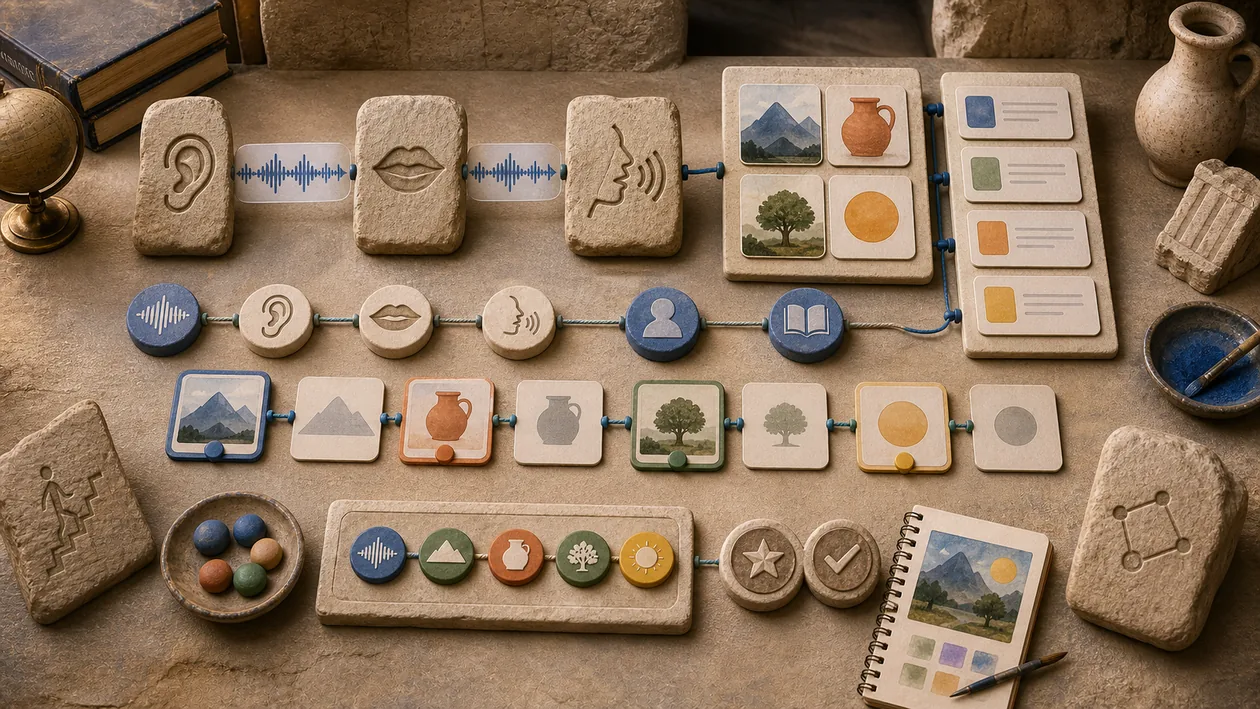
Rosetta Stone is an established language-learning software that helps users around the world learn new languages in an effective and intuitive way. With a focus on immersion methods and interactive exercises, Rosetta Stone offers a comprehensive platform suitable for both beginners and advanced learners. The app is available on various devices, including desktop and mobile apps, allowing flexible learning.
Who is Rosetta Stone suitable for?
Rosetta Stone is aimed at a broad audience. The platform is especially suitable for:
- Individuals who want to learn a new language from scratch.
- Professionals who want to improve their language skills for work.
- Pupils and students who want to practice alongside their classes.
- Travelers who want to quickly acquire basic language skills.
- Language enthusiasts who want to deepen their knowledge through regular practice.
By adapting to different learning levels and focusing on everyday communication, Rosetta Stone is suitable for both beginners and advanced learners.
Key features
- Immersive learning: Lessons are based on visual and audio contexts without translations to encourage natural language learning.
- Speech recognition technology: Interactive exercises with speech recognition help improve pronunciation and fluency.
- Versatile learning content: Includes vocabulary training, grammar exercises, listening comprehension, and speaking practice.
- Mobile and desktop access: Synchronization of learning progress across different devices.
- Personalized learning plans: Adaptation to individual learning goals and schedules.
- Live lessons (depending on plan): The option to practice online with native-speaking teachers.
- Offline mode: Learn without an active internet connection using downloadable lessons.
- Gamified elements: Rewards and progress indicators for motivation.
Typical Use Cases
- Focused rollout: Rosetta Stone is a good fit when operations, learning, and office teams want to stop improvising a recurring workflow around education, language, learning.
- Operations, not demos: The tool becomes more valuable when tasks, knowledge, coordination, and recurring routines are documented well enough to survive beyond a one-off trial.
- Team handovers: Rosetta Stone can make responsibilities clearer, so work does not disappear into chats, spreadsheets, or personal accounts.
- Quality control: A short review step is especially useful before outputs are published, automated further, or handed over to customers.
What really matters in daily use
In day-to-day work, Rosetta Stone is less about having every edge feature and more about whether the team understands where work starts, who reviews it, and how results move forward. A useful setup defines roles, naming rules, and the most important handover points before adoption.
Rosetta Stone is strongest when it reduces friction in an existing workflow instead of creating a second place to maintain. Before rolling it out widely, test it with real examples: which task becomes faster, which decision becomes clearer, and which manual check should intentionally remain?
Pros and cons
Pros
- Intuitive user interface that simplifies learning.
- Effective immersion method without translations promotes a feel for the language.
- Wide selection of languages, including less common ones.
- Flexible learning thanks to mobile apps and offline functionality.
- Speech recognition supports pronunciation improvement.
- Regular updates and expansions of the learning content.
Cons
- Subscription model can be costly for some users.
- No free full version, only a limited free trial.
- For advanced language learners, the content is partly too basic.
- Live lessons are often only included in higher subscription tiers.
- Some users find the immersion method without translations challenging.
Workflow Fit
Rosetta Stone fits best into a workflow with a clear input, a traceable work step, and a defined finish line. Small teams can usually keep the process lightweight; larger organizations should also define permissions, approvals, and integrations.
If Rosetta Stone becomes just another account without ownership, the value fades quickly. Give it a clear place in the existing stack: what enters the tool, what gets decided there, and where the result goes next.
Privacy & Data
Before adopting Rosetta Stone, clarify which data will enter the tool and whether documents, personal data, learning records, and internal notes are involved. The more sensitive the material, the more important permissions, retention rules, export options, and a documented decision on what should stay outside the tool become.
For European teams evaluating Rosetta Stone, data processing agreements, hosting information, and deletion processes are also worth checking. This is not a substitute for legal advice, but it avoids the common mistake of introducing Rosetta Stone before the data path is understood.
Editorial Assessment
Rosetta Stone is strongest when it is treated as one component in a clearly described workflow, not as a magic shortcut. The real benefit comes from less friction, clearer handovers, and more repeatable execution.
Our recommendation is to start with one concrete use case, write down success criteria, and review after two to four weeks whether Rosetta Stone genuinely saves time or simply creates another system to maintain. That keeps the decision grounded, even when the feature list is long.
Pricing & costs
Rosetta Stone is primarily offered as a subscription. Prices vary depending on the plan and term chosen. Typically, there are:
- Monthly subscriptions with flexible terms.
- Annual subscriptions that are cheaper in comparison.
- Family and group plans for multiple users.
- In some cases, additional features such as live lessons are only included in higher-priced packages.
A free trial period allows you to test the basic features before taking out a subscription.
Open frequently asked questions
FAQ
1. Which languages can I learn with Rosetta Stone?
What should a Rosetta Stone pilot look like?
Start with a bounded process, a small group and a clear success criterion. Check output quality, permissions and handovers before expanding the scope.
Which data should not be processed in Rosetta Stone without review?
Sensitive or confidential content should wait until contract terms, access, storage and deletion controls have been reviewed. Escalate uncertainty to the responsible privacy owner.
When is an alternative to Rosetta Stone the better choice?
Choose an alternative when the need is occasional, a required integration is missing, or administration and cost outweigh the practical benefit.
Rosetta Stone offers a wide range of languages, including English, Spanish, French, German, Italian, Japanese, Chinese, and more. The selection may vary depending on region and plan.
2. Do I need prior knowledge to start with Rosetta Stone? No, Rosetta Stone is designed for beginners, but advanced learners can also use the platform to deepen their knowledge.
3. How does speech recognition work? The integrated speech recognition analyzes the learner's pronunciation and provides feedback to improve speaking skills.
4. Can I use Rosetta Stone offline? Yes, lessons can be downloaded through the mobile apps and completed without an internet connection.
5. Is there a free version of Rosetta Stone? There is a free trial period, but full access to all content is available through paid subscriptions.
6. How flexible is learning with Rosetta Stone? The platform synchronizes progress across different devices, so users can learn anytime and anywhere.
7. Can I also speak with teachers live on Rosetta Stone? Live lessons are included in some subscription plans and make it possible to practice with native-speaking tutors.
8. How does Rosetta Stone differ from other language-learning apps? Rosetta Stone relies heavily on immersion without translations and uses a proven method based on visual and audio impressions, which sets it apart from many other apps.